O Desafio
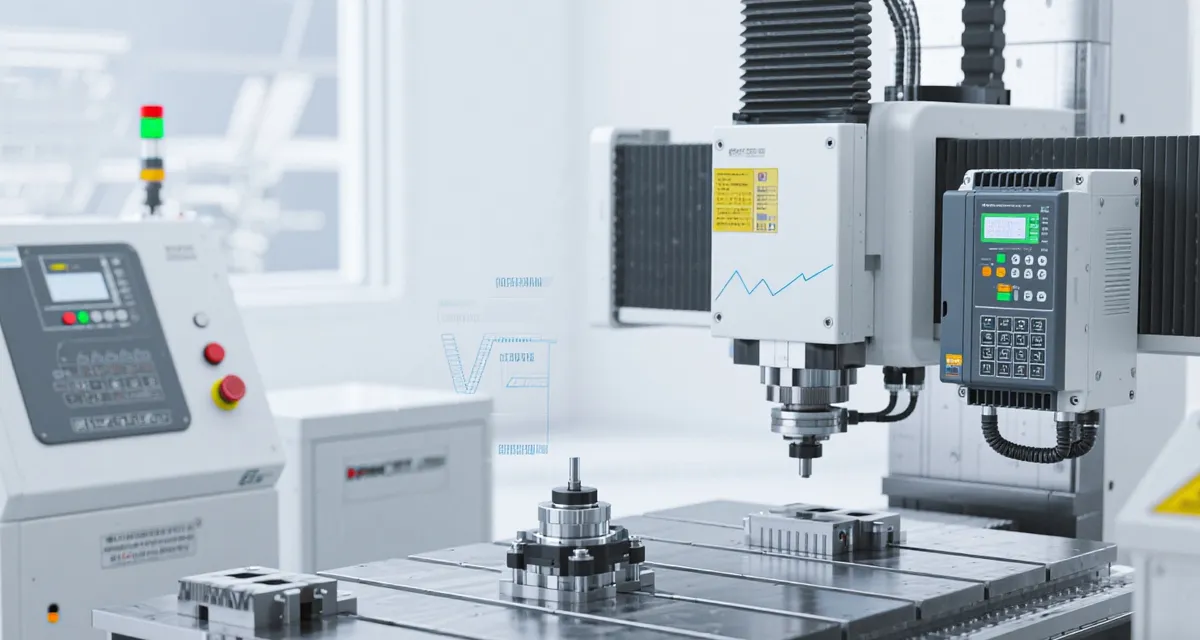
Nos modernos sistemas de máquinas-ferramenta CNC (comando numérico computadorizado), o inversor, como dispositivo central de controle de eletrônica de potência, tornou-se elo-chave entre o sistema de alimentação e o atuador, graças à regulação precisa de velocidade, saída de torque estável e gestão eficiente de energia. É amplamente usado em elos centrais como acionamento do spindle, transmissão de avanque e controle de funções auxiliares, dando suporte técnico importante para que máquinas CNC atinjam usinagem de alta precisão, eficiência e confiabilidade.
A Solução
Centering on the three core principles of "accurately matching process requirements, balancing performance and cost, and ensuring stable operation" — among which:
The process adaptability principle requires determining parameters such as spindle speed and feed precision based on machining scenarios, and matching inverters with technologies like vector control;
The system compatibility principle demands ensuring that inverters, CNC systems, motors, and detection components achieve data interaction through standardized interfaces;
The principle of balancing energy efficiency and reliability entails reducing energy consumption via functions like soft start and enhancing the protective design of inverters —
the design is developed in alignment with the characteristics of three key links: spindle, feed, and auxiliary functions:
For the spindle system, vector control inverters are selected according to motor power and speed requirements; closed-loop speed regulation and spindle orientation logic are designed, and parameters are optimized based on materials;
For the feed system, general-purpose or semi-closed-loop solutions are chosen for different scenarios, and V/F curves are adjusted according to load characteristics;
For the auxiliary system, small-sized inverters are used to realize the linkage between equipment and machining processes, with soft start and multiple protection configurations.
Meanwhile, system integration is completed through hardware measures (standardized wiring and heat dissipation design), software operations (no-load/load debugging by category), and communication adaptations (matching network segments and verifying real-time performance). Furthermore, an operation and maintenance plan — including real-time fault monitoring, regular equipment maintenance, spare parts stockpiling, and personnel training — is implemented to achieve efficient collaboration between inverters and CNC systems, providing overall support for machine tools to improve precision, optimize energy consumption, and enable intelligent operation.