Thách thức
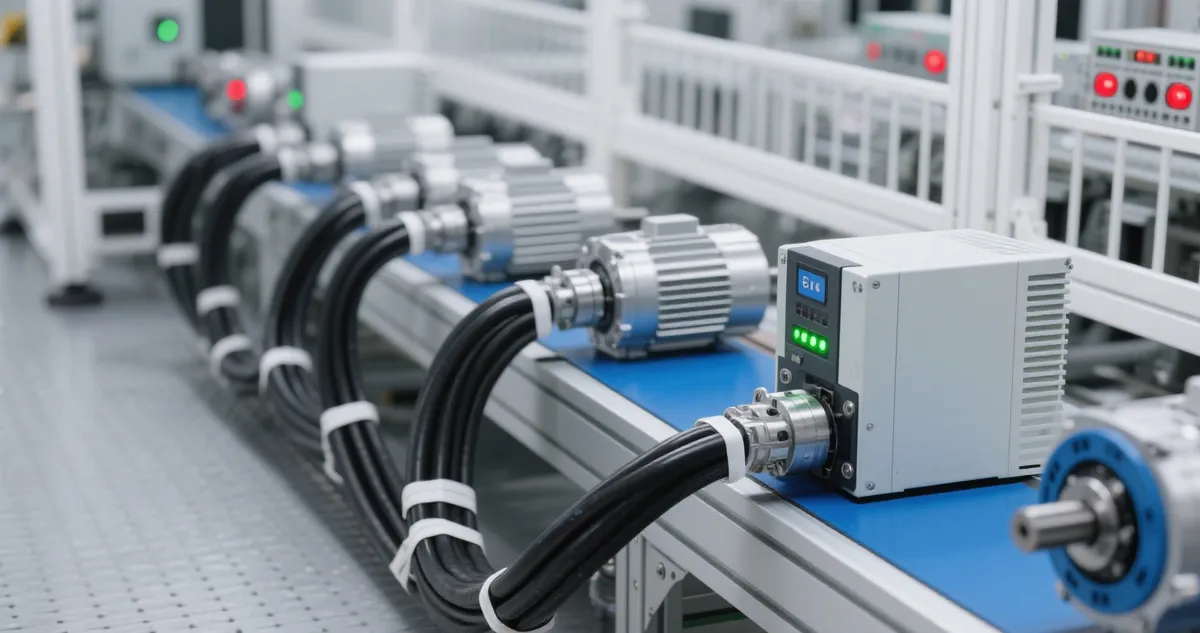
Trong sản xuất pin lithium-ion, mọi công đoạn — từ chuẩn bị điện cực, lắp ráp cell đến hóa thành và phân loại — đều đặt yêu cầu khắt khe về điều khiển tốc độ, lực căng và độ chính xác của thiết bị. Là thiết bị điện tử công suất lõi điều chỉnh tốc độ động cơ và tối ưu năng lượng, biến tần kiểm soát chính xác trạng thái vận hành động cơ bằng cách điều chỉnh tần số và điện áp nguồn ra. Không chỉ là linh kiện then chốt và “lõi điều chỉnh điện lực” của hệ thống thiết bị pin (bảo đảm hiệu suất sản xuất, chất lượng sản phẩm và ổn định công nghệ), biến tần còn là nền tảng bảo đảm chất lượng, hiệu suất và kiểm soát chi phí sản xuất pin lithium-ion. Khi công nghệ pin liên tục nâng cấp, biến tần tiếp tục tiến hóa về độ chính xác điều khiển, mức tích hợp và trí tuệ, thúc đẩy phát triển chất lượng cao của ngành sản xuất pin.
Giải pháp
Throughout the entire lithium-ion battery production process, equipment imposes high requirements on speed (e.g., coater speed adjustable from 5 to 20 m/min to match the thickness needs of different electrode sheets), tension (electrode sheet fluctuation ≤ ±3N to avoid wrinkling and stretching), and precision (winding alignment deviation ≤ 0.05mm to prevent cell short circuits). With "precision control, stable adaptation, and energy-efficient operation" as its core, the inverter forms an application solution covering the entire production process.
By means of customized selection (e.g., vector control inverters for front-end mixing to achieve smooth speed regulation from 0 to 1500 r/min; servo-type inverters for mid-end winding to reach a positional accuracy of ±0.01mm), multi-system linkage (real-time interaction with PLCs and tension/temperature sensors via the Profinet protocol to form closed-loop control), and full-lifecycle operation and maintenance, the inverter is integrated into equipment operation. This ensures cell consistency (qualified rate ≥ 99.5%) and stable production (fault downtime rate ≤ 0.1%), reduces costs and saves energy (average energy savings of 15%-30%, with the most significant savings achieved by the rear-end cooling fans), and adapts to process upgrades such as 4680 large cylindrical cells.
The solution adheres to three core principles: process adaptation, environmental resistance (IP54 protection for dusty environments, anti-corrosion coated models for corrosive environments), and system synergy. Broken down by process stages:
For the front-end, corresponding inverters and solutions are selected to ensure uniform and stable electrode sheets;
For the mid-end, specific solutions are used to meet the precise coordination of multiple axes;
For the rear-end, adaptive solutions are adopted to achieve temperature stability and energy savings during idling.
The implementation of the solution covers the entire process, including installation and commissioning (independent or integrated installation selected based on the environment, followed by a 12-hour test run after parameter calibration), operation and maintenance monitoring (establishment of a remote system and cleaning of heat dissipation channels every 3 months), and upgrade optimization. It helps improve the quality, reduce costs, and enhance efficiency of lithium-ion battery production, and serves as a comprehensive full-process solution integrating multiple factors. In the future, the integration of AI and digital twin technologies will better support intelligent manufacturing.