課題
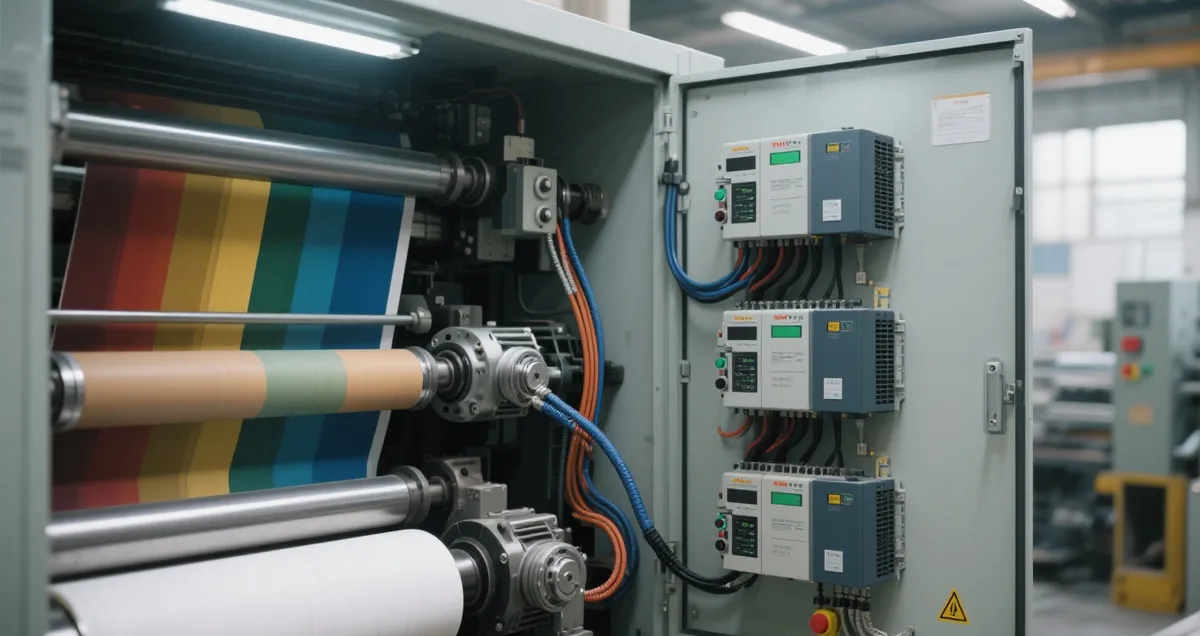
モータ速度の精密制御を可能にするパワーエレクトロニクス機器として、インバータは「必要時のみの速度調整・省エネ・安定運転」という中核優位性により、伝統的なオフセット印刷からフレキソ印刷、デジタル印刷に至る現代印刷システムの自動化・インテリジェント化に不可欠な中核部品です。出力電源の周波数と電圧を変えることで、印刷設備の各実行機構(主駆動モータ、給紙モータ、乾燥モータなど)を駆動し、従来印刷設備の「定速運転・高消費エネルギー・速度調整困難・同期性不良」といった課題を根本的に解決。印刷品質・生産効率・設備信頼性を大幅に向上させます。
ソリューション
Inverter Application Solution for Modern Printing Systems
To meet the core demands of the modern printing industry—including efficient production, quality control, and energy conservation—this solution integrates high-performance inverters into the key processes of printing systems, establishing a precise, coordinated, and intelligent motor drive control system.
The solution covers all scenarios of traditional offset printing, flexographic printing, and digital printing. For core links such as paper feeding, main printing drive, drying & curing, and winding & rewinding, it configures frequency conversion drive schemes adapted to different process requirements:
In the paper feeding and winding processes, tension closed-loop control inverters are adopted. These inverters dynamically adjust motor speed by real-time monitoring the tension of the substrate, ensuring a stable and error-free conveying process.
In the multi-color printing main drive system, master-slave synchronous control inverters are applied to achieve micron-level speed synchronization of each color drum, guaranteeing overprinting accuracy.
In the drying system, frequency-conversion speed-regulating fans are matched. These fans intelligently adjust air volume and heat output according to printing speed, optimizing energy efficiency.
The system adopts a "PLC centralized control + inverter distributed execution" architecture. Through an industrial bus, it realizes real-time communication between each frequency conversion unit and the central control system, supporting one-click printing speed switching, multi-process coordinated speed regulation, and fault early warning—greatly shortening the order change adjustment time.
With both strong anti-interference design and adaptability to harsh environments, the solution can effectively cope with complex working conditions in printing workshops, such as dust and electromagnetic interference. After implementation, it not only addresses issues of traditional printing equipment (e.g., poor synchronization, excessive energy consumption, and severe mechanical wear) but also reduces comprehensive energy consumption by 20%-40% and extends the equipment maintenance cycle by more than 30%. It provides core technical support for printing enterprises to achieve automated production, flexible manufacturing transformation, and green production goals.