The Challenge
As a power electronic device capable of achieving precise control of motor speed, the inverter, by virtue of its core advantages of "speed regulation on demand, energy conservation and consumption reduction, and stable operation", has become a key core component for modern printing systems (from traditional offset printing, flexographic printing to digital printing) to realize automated and intelligent production. By changing the frequency and voltage of the output power supply, it drives the motors of various executive mechanisms in printing equipment (such as main drive motors, paper feeding motors, drying motors, etc.), fundamentally solving the pain points of traditional printing equipment, such as "constant-speed operation, high energy consumption, difficult speed regulation, and poor synchronization", and significantly improving the quality of printed products, production efficiency and equipment reliability.
The Solution
Inverter Application Solution for Modern Printing Systems
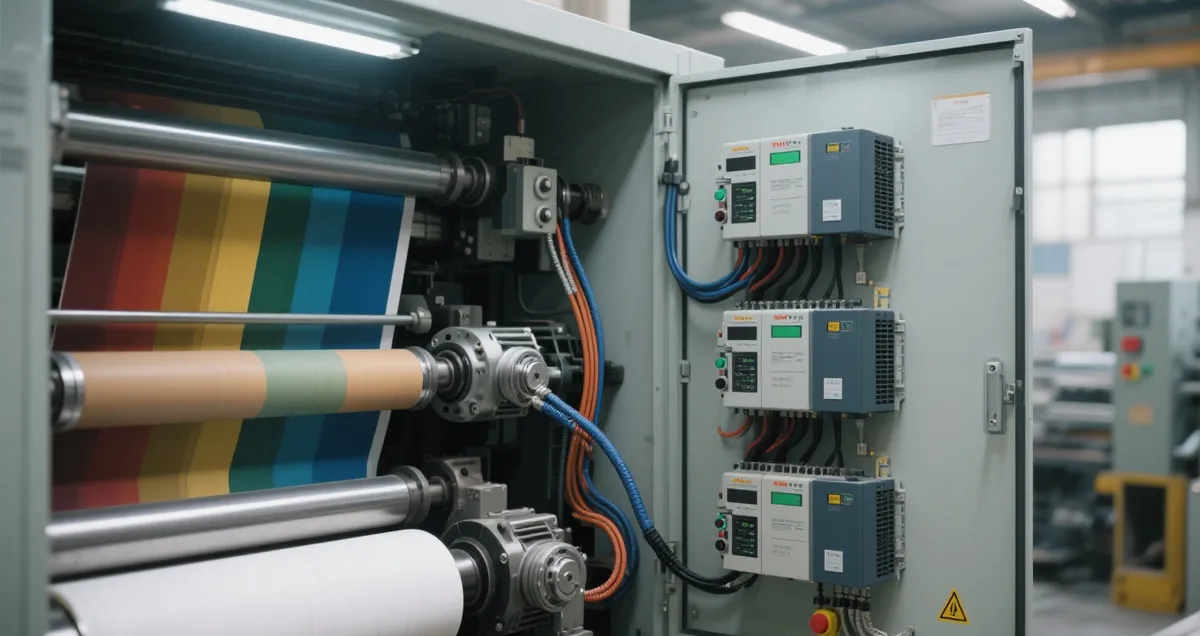
To meet the core demands of the modern printing industry—including efficient production, quality control, and energy conservation—this solution integrates high-performance inverters into the key processes of printing systems, establishing a precise, coordinated, and intelligent motor drive control system.
The solution covers all scenarios of traditional offset printing, flexographic printing, and digital printing. For core links such as paper feeding, main printing drive, drying & curing, and winding & rewinding, it configures frequency conversion drive schemes adapted to different process requirements:
In the paper feeding and winding processes, tension closed-loop control inverters are adopted. These inverters dynamically adjust motor speed by real-time monitoring the tension of the substrate, ensuring a stable and error-free conveying process.
In the multi-color printing main drive system, master-slave synchronous control inverters are applied to achieve micron-level speed synchronization of each color drum, guaranteeing overprinting accuracy.
In the drying system, frequency-conversion speed-regulating fans are matched. These fans intelligently adjust air volume and heat output according to printing speed, optimizing energy efficiency.
The system adopts a "PLC centralized control + inverter distributed execution" architecture. Through an industrial bus, it realizes real-time communication between each frequency conversion unit and the central control system, supporting one-click printing speed switching, multi-process coordinated speed regulation, and fault early warning—greatly shortening the order change adjustment time.
With both strong anti-interference design and adaptability to harsh environments, the solution can effectively cope with complex working conditions in printing workshops, such as dust and electromagnetic interference. After implementation, it not only addresses issues of traditional printing equipment (e.g., poor synchronization, excessive energy consumption, and severe mechanical wear) but also reduces comprehensive energy consumption by 20%-40% and extends the equipment maintenance cycle by more than 30%. It provides core technical support for printing enterprises to achieve automated production, flexible manufacturing transformation, and green production goals.