ความท้าทาย
ในฐานะอุปกรณ์อิเล็กทรอนิกส์กำลังที่ควบคุมความเร็วมอเตอร์ได้อย่างแม่นยำ อินเวอร์เตอร์ด้วยข้อได้เปรียบหลัก การปรับความเร็วตามความต้องการ การประหยัดพลังงาน และการเดินเครื่องที่เสถียร กลายเป็นองค์ประกอบหลักของระบบการพิมพ์สมัยใหม่ (ตั้งแต่ออฟเซ็ตและเฟลกโซแบบดั้งเดิมจนถึงการพิมพ์ดิจิทัล) เพื่อการผลิตแบบอัตโนมัติและอัจฉริยะ ด้วยการเปลี่ยนความถี่และแรงดันของไฟขาออก อินเวอร์เตอร์ขับมอเตอร์ของกลไกต่าง ๆ ในเครื่องพิมพ์ (มอเตอร์ขับหลัก มอเตอร์ป้อนกระดาษ มอเตอร์อบแห้ง ฯลฯ) แก้ปัญหาเชิงรากของอุปกรณ์พิมพ์แบบเดิม เช่น เดินความเร็วคงที่ ใช้พลังงานสูง ปรับความเร็วยาก และการซิงโครไนซ์ที่แย่ ยกระดับคุณภาพงานพิมพ์ ประสิทธิภาพการผลิต และความน่าเชื่อถือของอุปกรณ์อย่างมีนัยสำคัญ
โซลูชัน
Inverter Application Solution for Modern Printing Systems
To meet the core demands of the modern printing industry—including efficient production, quality control, and energy conservation—this solution integrates high-performance inverters into the key processes of printing systems, establishing a precise, coordinated, and intelligent motor drive control system.
The solution covers all scenarios of traditional offset printing, flexographic printing, and digital printing. For core links such as paper feeding, main printing drive, drying & curing, and winding & rewinding, it configures frequency conversion drive schemes adapted to different process requirements:
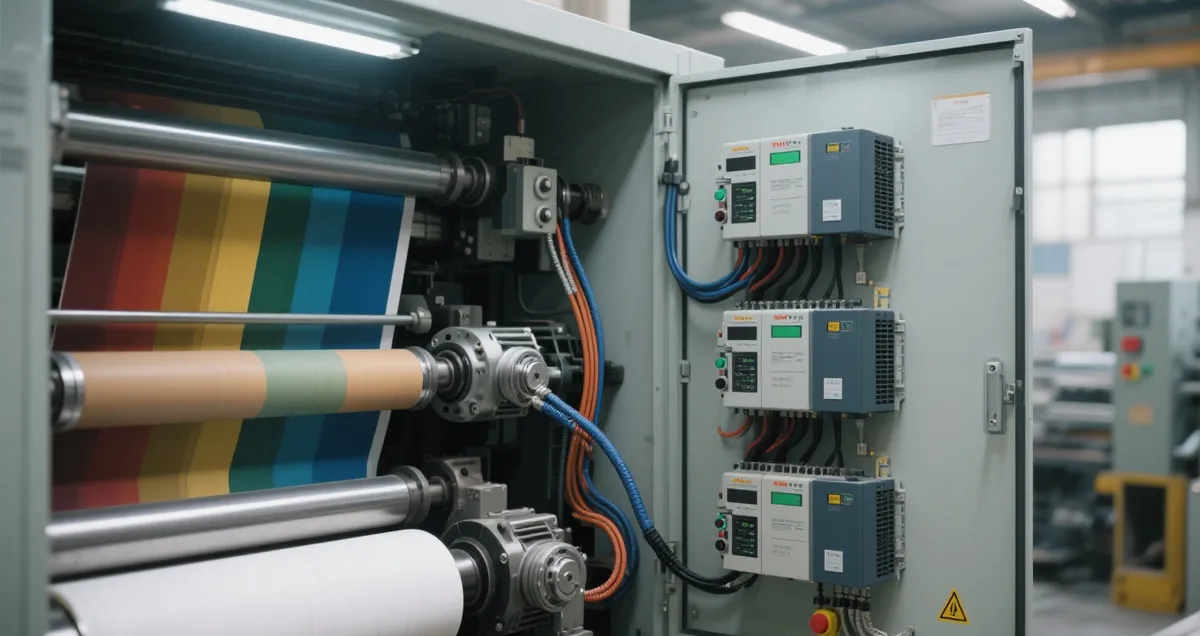
In the paper feeding and winding processes, tension closed-loop control inverters are adopted. These inverters dynamically adjust motor speed by real-time monitoring the tension of the substrate, ensuring a stable and error-free conveying process.
In the multi-color printing main drive system, master-slave synchronous control inverters are applied to achieve micron-level speed synchronization of each color drum, guaranteeing overprinting accuracy.
In the drying system, frequency-conversion speed-regulating fans are matched. These fans intelligently adjust air volume and heat output according to printing speed, optimizing energy efficiency.
The system adopts a "PLC centralized control + inverter distributed execution" architecture. Through an industrial bus, it realizes real-time communication between each frequency conversion unit and the central control system, supporting one-click printing speed switching, multi-process coordinated speed regulation, and fault early warning—greatly shortening the order change adjustment time.
With both strong anti-interference design and adaptability to harsh environments, the solution can effectively cope with complex working conditions in printing workshops, such as dust and electromagnetic interference. After implementation, it not only addresses issues of traditional printing equipment (e.g., poor synchronization, excessive energy consumption, and severe mechanical wear) but also reduces comprehensive energy consumption by 20%-40% and extends the equipment maintenance cycle by more than 30%. It provides core technical support for printing enterprises to achieve automated production, flexible manufacturing transformation, and green production goals.