The Challenge
Inverters have evolved from "optional equipment" to "essential equipment" in mining systems. Their application not only addresses the "high energy consumption, high wear and tear, and low efficiency" issues of traditional power-frequency drives but also serves as a core pillar for the intelligent transformation of mines.
In the future, with the continuous advancement of explosion-proof technology, Internet of Things (IoT) technology, and energy-saving algorithms, inverters will be deeply integrated into the "unmanned mining and intelligent management and control" system of mines, providing crucial technical support for mines to achieve "safe, efficient, and green" production.
The Solution
The main underground ventilator in coal mines is a core auxiliary equipment for ensuring underground air quality and diluting gas concentration, which requires 24-hour continuous operation. Traditional power-frequency drives have pain points such as "high energy consumption for air volume adjustment (air door throttling loss reaches 30%-50%), large starting impact (inrush current is 5-7 times the rated value), and slow gas linkage response". For this scenario, inverter application solution takes "safety and explosion prevention as the premise, on-demand air supply for energy conservation as the core, and intelligent linkage to ensure safety" as its goals, so as to achieve efficient and safe operation of the ventilator. The basic plan is as follows:
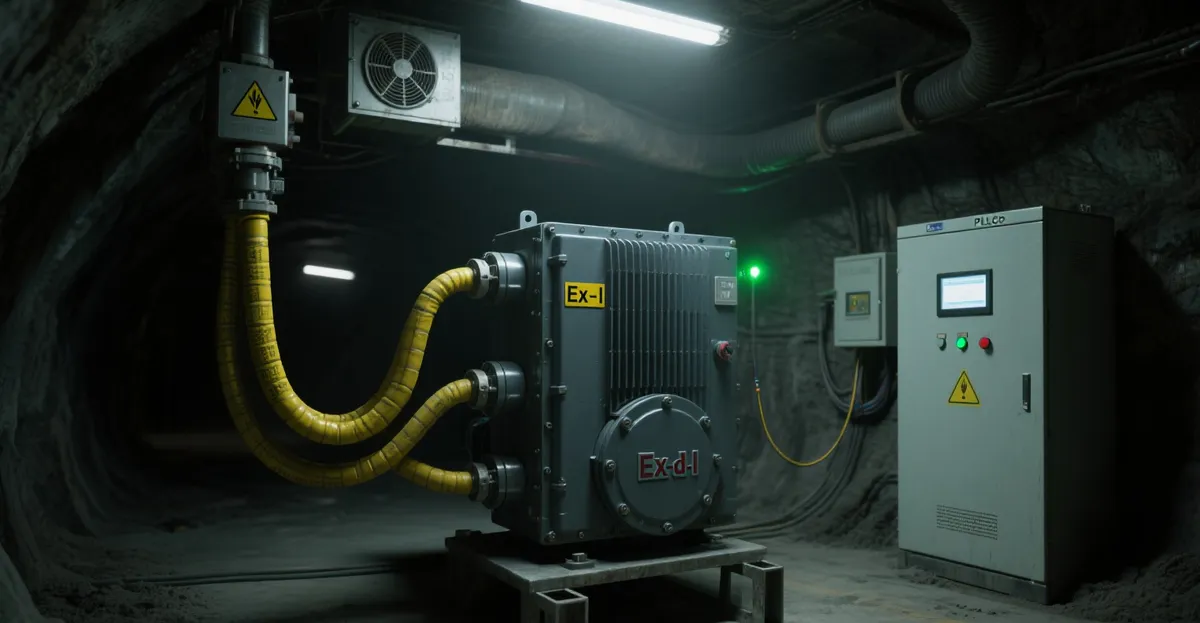
inverter selection: Focus on explosion prevention and stability, and select flameproof vector control inverters.
Control logic: Dynamic speed regulation with gas linkage, which is deeply linked with the underground gas monitoring system and PLC control cabinet to build a "gas concentration - air volume" closed-loop control.
Installation and protection: Adapt to the harsh underground environment to avoid causing safety risks.