The Challenge
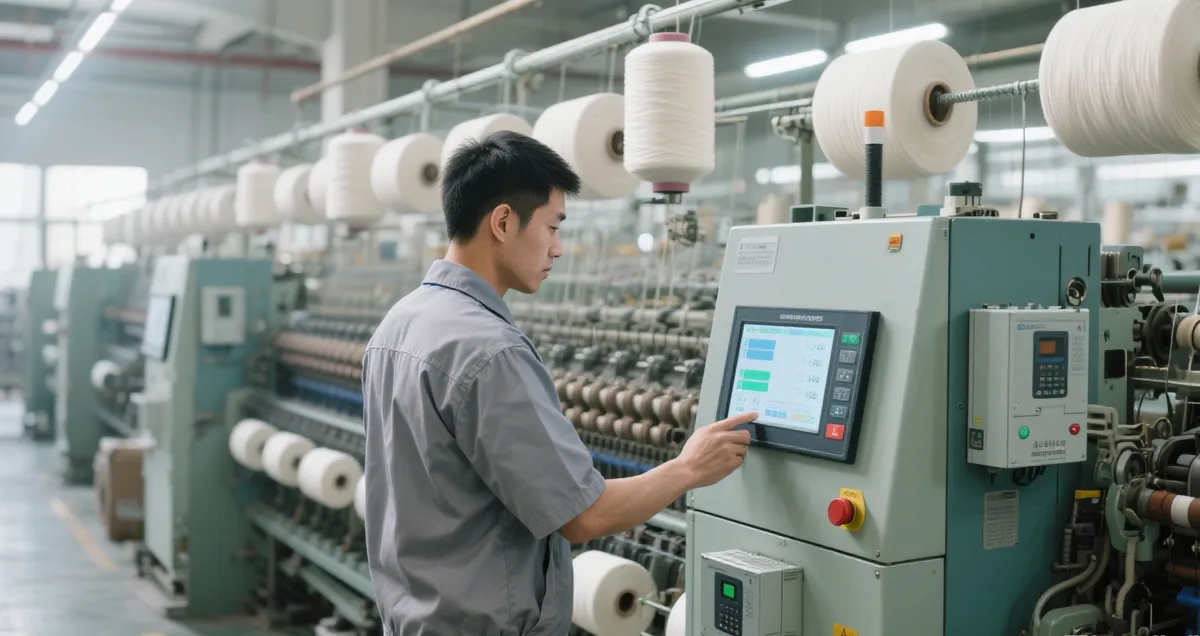
In the modern production system of the textile industry, the entire process from fiber processing to the production of finished fabrics has extremely high requirements for the stability of equipment operation, speed regulation accuracy, and energy utilization efficiency. As a power electronic device capable of achieving stepless speed regulation of motors, the inverter, by virtue of its precise speed control, soft-start protection, and energy consumption optimization capabilities, has become an indispensable core control component in textile systems. It is widely used in key production links such as spinning, weaving, and dyeing & finishing, effectively solving the pain points of traditional textile equipment, such as difficult speed regulation, high energy consumption, and large mechanical wear. It provides important technical support for textile enterprises to achieve efficient, energy-saving, and intelligent production.
The Solution
Customized Inverter Application Scheme for Textile Production
Through customized hardware selection, software programming, and system integration, the scheme covers three core links of textile production: spinning, weaving, and dyeing & finishing.
Spinning Link: Adopts the "inverter + PLC + sensor" architecture. Ring spinning machines are equipped with 11kW-37kW vector-type inverters; drawing frames realize multi-motor synchronous control; and an energy-saving mode is activated during no-load operation.
Weaving Link: Uses inverters with a response time of ≤10ms, which are matched with encoders to achieve speed synchronization (with deviation controlled within ±1r/min). Touchscreens are used for convenient parameter modification.
Dyeing & Finishing Link: Takes "temperature-speed coordination" as the core. Dyeing machines are equipped with inverters with PID temperature control; setting machines adopt multi-inverter linkage and are matched with waste heat recovery devices (reducing energy consumption by 15%-20%); dryers adjust speed according to humidity.
The implementation of the scheme involves three phases: research and analysis, selection-installation-commissioning, and personnel training (the cycle for 50 sets of equipment is 1-2 months). It is expected to achieve the following effects: shorten equipment adjustment time by 30%-50%, increase product qualification rate by 5%-8%, reduce electrical energy consumption by 12%-18%, and decrease equipment wear by 25%-30% (extending service life by 3-5 years). Additionally, the scheme can connect with PLC and MES systems to realize real-time data monitoring, providing a technical path for enterprises to achieve efficient, energy-saving, and intelligent production.